 kNaru
kNaru0online

Here are two Game Boy Advance SPs.

They just look like regular Game Boy Advance SPs. One is a limited edition Famicom Color variation, and the other is black. Nothing particularly stands out.

But... when you turn them on, something's different. The screen... the screen is different.

Turning on a game makes the difference even more obvious. Many of you probably already know, but the one on the left is the standard Game Boy Advance SP, model AGS-001, and the one on the right is the backlit model I just bought, the AGS-101.

The easiest and most accurate way to tell them apart is by looking at the Model No. on the back of the unit. Personally, I managed to snag it quickly on Karrot Market for cheaper than market price, but this guy on the right is surprisingly hard to find. So, how did this weird variant of the GBA SP come about?

The screen, or more precisely the LCD (Liquid Crystal Display), has its pixels sandwiched between polarizing films. Light has to pass through for the screen's image to be properly visible to the human eye. Even now, with LCD screens in the Switch 2, the manufacturing differences are huge, but the basic structure is the same. Back in the 80s when technology was slow, the original "Game Boy" debuted. Adding a backlight, meaning a layer of white light behind the LCD to illuminate it, was very expensive and consumed a lot of power.

So, what they used was a reflector. When it received enough light, including sunlight, the reflector on the back of the LCD would simply bounce it back, making the screen visible. This means, back then, **if it was dark, you couldn't see the game screen.**


But they say humans are adaptable. Even back then, there were kids who somehow played games at night by shining a simple, crude flashlight in front of the Game Boy screen.
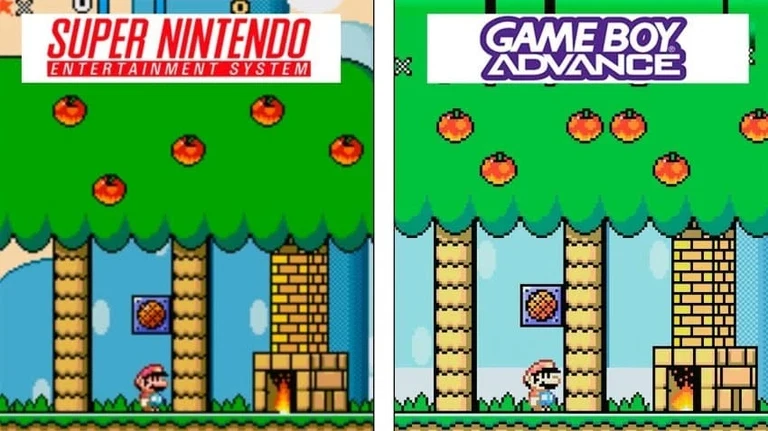
Of course, Nintendo knew this. In 1998, they released the "Game Boy Light" in Japan only. It wasn't a backlight, but a frontlight, meaning it emitted a weak, strange fluorescent light from above the LCD, not quite green or blue. However, it was ahead of its time in many ways. The Game Boy Color and its successor, the Game Boy Advance, which were released shortly after, also used the reflector method. Accessory companies that sold small lights to shine on the screen were still doing well. For this reason, early Game Boy Advance games were intentionally developed with brighter screens than what was intended, so they would be more visible on the reflector-based GBA.

Like this. ↑

Then, finally, 14 years after the Game Boy's debut, in 2003, the Game Boy Advance SP, an improved version of the GBA, adopted the frontlight method again after the Game Boy Light. This allowed games to be played even in dark rooms. However, as soon as the SP adopted frontlighting, white LEDs, which are easy to use for backlighting, started being mass-produced in the electronics industry, and backlight technology rapidly became commercially viable for mass production. That's how the "Game Boy Micro" and the "Game Boy Advance AGS-101" were born, released in September 2005.

Let's compare the screens of the 4 GBA models: the pathetic screen of the reflector-based GBA (bottom left), the still somewhat visible frontlit SP (top left), and the crisp, backlit AGS-101 (top right) and Micro (bottom right). ↑

It looks like this when you turn off the lights. The reflector GBA is obviously unreadable, the frontlit SP is just barely visible, and the 101 and Micro are perfectly playable. ↑

So, did the AGS-101 and Micro sell like hotcakes as the ultimate GBAs? No. The year before they were released, in 2004, the GBA's successor, the Nintendo DS, had already come out. Why would anyone buy a previous generation console when a successor is already available? Naturally, their sales were very low, and they weren't even released in many countries. That's why they're hard to find now.

Left is the "Nintendo DS" released in 2004. The familiar one on the right is the "Nintendo DS Lite" released in 2006. ↑
"Users are surprised to learn that the AGS-101 is rare and appreciate the history of console screen tech, while some share nostalgic memories."
#FunNo comments yet.